
Defenders of Hogwarts Rules: The Complete Rulebook Guide
Defenders of Hogwarts is a deck-building board game from MinaLima, the graphic design studio behind the Harry Potter films. It is a physical tabletop game, not a video game or a tabletop RPG — if you searched for a "Harry Potter Defenders RPG game", this page tells you what you are actually buying and how it plays. Everything below follows the official rulebook, which MinaLima publishes free as a PDF.
At a glance
| Players | 2–5 (one Dark Arts Player, 1–4 House Players) |
|---|---|
| Play time | 90 min on the rulebook cover (BoardGameGeek: 90–180) |
| Age | 13+ |
| Designer | David Waterman |
| Publisher | MinaLima |
| Weight | Light (1.3 on BoardGameGeek) |
| Language | English only, language dependent |
1. What you are trying to do
The story: Death Eaters and Dark Forces have got into Hogwarts and Lord Voldemort is expected to arrive. One player is the Dark Arts Player. Everyone else is a House Player and takes one of the four houses. The rulebook recommends giving the Dark Arts role to whoever knows the rules best.
- A House Player wins the moment they collect two Defence Shields. Each house races on its own — you can coordinate with the other houses, but only one of you wins.
- The Dark Arts Player wins by taking all three Progress Tokens from the Dark Arts Path and then getting the required number of Dark Arts Pawns onto their secret Location at the same time.
- A draw happens if the Dark Arts Marker has reached the end of the path and every player runs out of cards before anyone wins.
There are no hidden roles and no traitor mechanic. The tension comes from one player working against the table while the houses compete with each other for the same shields.
2. What is in the box
- A Main Board (a map of Hogwarts) and a Side Board (the Dark Arts Path and the Hogwarts Loyalty Track)
- Four House Player Boards and one Dark Arts Player Board
- Four pawns per house, seven Dark Arts Pawns, four House Markers and a Dark Arts Marker
- Seven Hogwarts Tokens, three Dark Arts Progress Tokens, the Dark Detector, four D.A. Coins, eight Parchment Scrolls and six Defence Shields
- Card decks: a seven-card starter deck for each house and for the Dark Arts Player, a House Player Acquire Deck (42), a Dark Arts Acquire Deck (20), a Library Book Deck (11), Location Decks for both sides, and fifteen Event Cards in white, orange and red
- A Room of Requirement board piece and five Player Aid Cards
3. Setup
Main Board
- Shuffle the Defence Shields and place one face up on each Defence Shield Space.
- Put the seven Hogwarts Tokens on their spaces.
- Place three of each House Player's four pawns in the Great Hall.
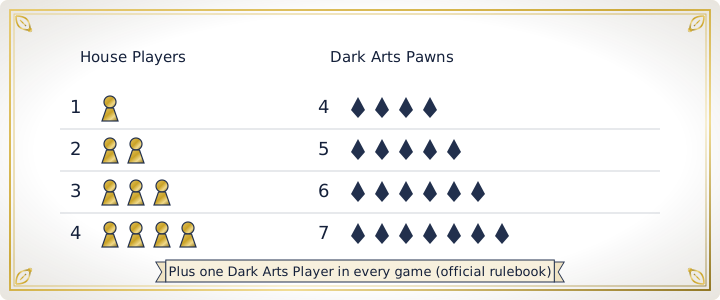
- Give the Dark Arts Player pawns by number of House Players, put four on the Deployment Spaces and keep the rest in front of them:
| House Players | Dark Arts Pawns |
|---|---|
| 1 | 4 |
| 2 | 5 |
| 3 | 6 |
| 4 | 7 |
Side Board
- Reveal two Library Book Cards.
- Deal two House Player Acquire cards to the Advanced Acquire Row and two to the Acquire Row.
- Put the Dark Arts Marker on the first space of the Dark Arts Path and the three Progress Tokens on their spaces.
- Put the Dark Detector on the Hogwarts Loyalty Track and each house's fourth pawn on the track's first space.
- Shuffle both Location Decks face down.
Player boards
- Each player shuffles their starter deck onto their Draw Space and draws five cards.
- Each House Player puts their House Marker on their Items Space and draws three House Player Location Cards.
- The Dark Arts Player sorts the Event Cards by colour into three shuffled decks.
4. Turn order
The House Player to the left of the Dark Arts Player goes first, then play continues clockwise until someone wins or the game ends in a draw.
5. The House Player turn
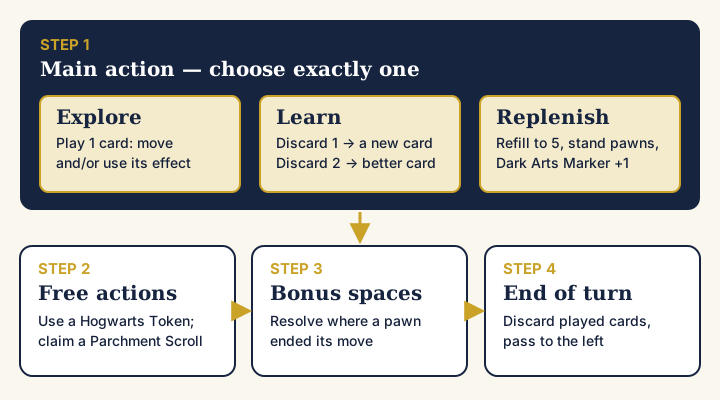
Step 1 — choose one main action:
- Explore. Play one card from your hand and resolve its movement and/or effect, in either order.
- Learn. Discard one card to take a face-up card from the Acquire Row or the top card of the Acquire Deck; or discard two cards to take a card from the Advanced Acquire Row and move one space up the Hogwarts Loyalty Track. New cards go on top of your Draw Deck, so you draw them soon. You need at least one pawn outside a Protected Area to Learn.
- Replenish. In order: discard any number of cards and draw back up to five, stand up your stunned pawns, then advance the Dark Arts Marker one space. Replenishing helps you and pushes the game toward the Dark Arts Player's endgame.
Step 2 — free actions, as many as you can afford:
- Use a Hogwarts Token gained on an earlier turn: return it and take an extra Explore action with a card of that token's type. You can hold only one token at a time.
- Gain a Parchment Scroll: if you have pawns in two of the three areas shown on your Location Cards, reveal and discard those two cards and take a scroll.
Step 3 — bonus spaces. Resolve any bonus space where one of your pawns ended its move.
Step 4 — end of turn. Discard the cards you played and pass to the left.
When your Draw Deck runs out, shuffle your discard pile to form a new one. Your hand size is five.
6. The Dark Arts Player turn
- Explore. Play one card and resolve it. How much of the card works depends on where the Dark Arts Marker is: white effects are always on, orange effects unlock once the marker reaches the first orange space, red effects once it reaches the first red space.
- Replenish. Stand up stunned pawns, then draw back up to five. The Dark Arts Player cannot discard.
Then discard played cards and pass to the left.
7. Moving around Hogwarts
- A movement value lets one pawn move up to that many spaces. Adjacent spaces share a full border.
- A card with two values lets you move two pawns (one value each) or one pawn the combined total — no other split.
- You cannot backtrack within a turn.
- Locked doors, protective spells, physical objects and water block House Players unless a card says otherwise. Dark Arts Pawns ignore obstacles.
- The four Protected Areas (spaces with a blue shield icon, such as Hagrid's Hut) cannot be entered or crossed by Dark Arts Pawns.
- Fly Off Points let any pawn fly between them for free when a card allows it. Secret Passageways are for House Players only, through specific cards, and cost one movement point.
- Bringing a Dark Arts Pawn onto the board costs one movement point and needs an empty Deployment Space.
8. Stunning and bumping
- Stun: if a House Player pawn ends its move on a Dark Arts Pawn, both are stunned (laid on their side) and the House Player moves the Dark Arts Pawn to an adjacent space. Stunned pawns cannot move until their owner Replenishes.
- Bump: if a Dark Arts Pawn ends its move on a House Player pawn, that pawn goes back to the Great Hall and the Dark Arts Player takes that house's marker. Once per turn they also draw two Dark Arts Acquire cards and keep one. Holding every House Marker advances the Dark Arts Marker one space, and the markers go back to their owners.
9. Items and Defence Shields
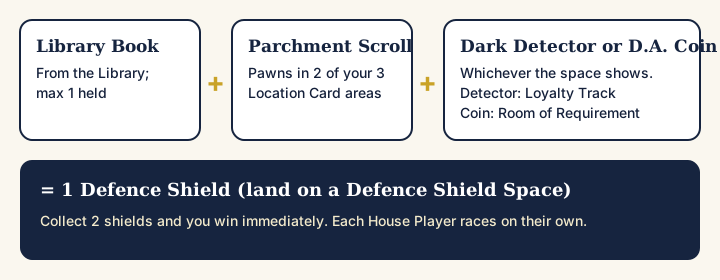
To take a shield, land a pawn on a Defence Shield Space while holding the three items that space asks for, then hand them in:
- A Library Book Card — taken in the Library if you have none (one at a time); its effect resolves straight away.
- A Parchment Scroll — earned from your Location Cards (see the House Player turn). After your first scroll you refill to three Location Cards; after your second you discard the last one and draw no more.
- The Dark Detector or a D.A. Coin, whichever the space shows. There is one Dark Detector. You earn it on the Hogwarts Loyalty Track by being furthest along at space five or higher; giving it up for a shield drops your pawn three spaces. D.A. Coins (one per player) are found in the Room of Requirement.
The Hogwarts Loyalty Track has seven spaces. You climb it by landing on Dark Detector icons, through certain cards, or with the two-card Learn action. The first time any pawn reaches space five, the Room of Requirement appears on the board; it is removed again if every house drops below space five.
10. The Dark Arts Path and events
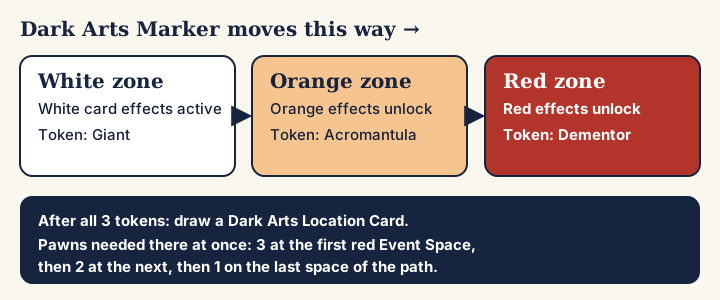
The Dark Arts Marker moves along a path split into white, orange and red zones. It advances when a House Player Replenishes, when an event says so, and when the Dark Arts Player has collected every House Marker.
- Landing on an Event Space draws the top Event Card of that colour. House Players resolve their part first; then the Dark Arts Player chooses either the event's effect or that zone's Progress Token.
- Each zone's token must be taken before the marker moves into the next zone: the Giant (white), the Acromantula (orange) and the Dementor (red).
- With all three tokens, the Dark Arts Player draws a Dark Arts Location Card. To win they must have three pawns on that location together at the first red Event Space, two at the next, and one on the last space of the path.
11. The endgame
When the marker reaches the last space, the Dark Arts Player takes a Location Card if they do not have one, every player draws up to five cards, and no one can Replenish again. Play continues with the cards in hand. If a House Player completes two shields, or the Dark Arts Player gets one pawn onto their location, that player wins; if everyone runs out of cards first, the game is a draw.
The rulebook has no separate campaign mode or save system: a game is one sitting. Voldemort's arrival is the story behind the Dark Arts Path rather than a distinct phase with its own rules.
Rules FAQ
How many players does Defenders of Hogwarts need?
Two to five: one Dark Arts Player and one to four House Players. With two players it becomes a head-to-head duel between the Dark Arts Player and a single house.
Is Defenders of Hogwarts an RPG?
No. It is a deck-building board game with a story frame. There is no game master, no character sheet and no improvised play; everything runs on cards, the board and the rulebook.
Is it cooperative?
Not in the usual sense. The House Players share an opponent, and the rulebook says they may band together, but each House Player wins alone by being first to collect two Defence Shields.
Is there a hidden traitor or secret loyalty card?
No. The rulebook has no hidden roles. The Dark Arts Player is chosen openly at setup. The "Hogwarts Loyalty Track" is a public track that House Players climb to earn the Dark Detector and open the Room of Requirement.
Do I need to know Harry Potter to play?
No. The rules are self-contained. Knowing the setting helps with the flavour of the cards and locations, but it is not required.
Is the game language dependent?
Yes. Cards carry rules text, so every player needs to read English comfortably.
What happens if nobody wins?
Once the Dark Arts Marker reaches the last space of the Dark Arts Path, nobody may Replenish again. If every player runs out of cards before anyone has won, the game is a draw.
Source: rules summarised from the official rulebook published by MinaLima. Where this page and the rulebook differ, the rulebook wins.
Keep reading
 How to Play Defenders of Hogwarts A first-game walkthrough: what to do on turn one and the mistakes new tables make.
 Defenders of Hogwarts Review Who the game is for, what it does well and where it falls short.
 Defenders of Hogwarts vs Hogwarts Battle Defenders of Hogwarts against the co-op Hogwarts Battle deck-builder.
 Defenders of Hogwarts FAQ Quick answers on players, language, release dates and buying.